

Mission & Vision
To deliver rice-based innovations and transformed rice-based agri-food systems that contribute to the transformation of food, land and water systems in the face of climate change.
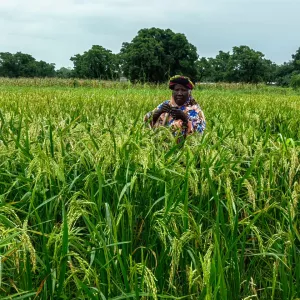
Mission Statement
The mission of AfricaRice is to deliver rice-based innovations and transformed rice-based agri-food systems that contribute to the transformation of food, land and water systems in the face of climate change.
Strategy
The 2030 Rice Research and Innovation Strategy for Africa takes into account the new realities, challenges and aspirations of stakeholders in the rice sector in Africa as well as the need to ensure compliance with the One CGIAR 2030 Research and Innovation Strategy. It will guide action towards transforming rice-based agri-food systems to improve nutrition, health and food security, while also spurring economic growth. The strategy aims to build capacities to adapt to and mitigate climate change and maintain environmental health.
As an R4D center of excellence, AfricaRice will build on its expertise in rice seed conservation and use, and work with its national, regional and international partners to promote innovative rice breeding programs, crop management practices and seed systems. The approach aims to ensure that AfricaRice and its partner institutions will take a more holistic approach to addressing rice research challenges and endeavor to provide solutions in the context of a global research for development alliance.
While fully nested in One CGIAR 2030, the strategy remains unique in its design to respond to the challenges of rice-based agri-food systems in Africa. While fully aligned to national, regional and continental research for development (R4D) strategies, it aims to contribute positively to achieving all the Sustainable Development Goals (SDGs), especially that of zero hunger (SDG 2).
It will facilitate strong public-private partnerships (PPPs) and build capacities to support the development and implementation of effective business models and thriving markets. AfricaRice has the credibility and capability to strengthen and broker relationships among a broad range of stakeholders, which will be a key route to success in ensuring that the transformation agenda delivers desired impacts.
As part of One CGIAR, AfricaRice will be able to attract additional financial and technical resources, which will assist member countries to achieve their goals. Key stakeholders will include the regional economic commissions and their technical arms, government ministries, private sector entrepreneurs, civil society, extension services and farmer cooperatives.
The new strategy has sought ownership from all categories of rice stakeholders in Africa to ensure that collective responsibilities are fully understood, and all stakeholders are dedicated to the effective transformation of rice-based agri-food systems for a healthier Africa.
Ethics
We are all accountable.
CGIAR recognizes that operating according to the highest ethical standards is a prerequisite to being able to deliver on our vision. As part of CGIAR, AfricaRice adheres to the Core Ethical Values of Integrity, Dignity and Respect, Sustainability, Excellence and Innovation, and Partnership, as set forth in the CGIAR Ethics Framework.
To ensure accountability, AfricaRice welcomes reporting of any illegal or unethical conduct (e.g., corruption, fraud, misuse of resources, abuse of authority, etc.) by anyone associated with our work. Our reporting mechanisms are available to everyone: staff, partners, contractors, suppliers, and anyone else who interacts with AfricaRice, including the public at large.
AfricaRice does not tolerate illegal or unethical conduct and will do whatever is reasonably possible to prevent, deter, identify, and sanction such behaviors.
If you are an employee, please be sure to read the applicable internal policies which describe relevant reporting procedures and consider following those procedures first.
How to Report
There are multiple options to report misconduct. The two main avenues are CGIAR’s whistleblowing hotline and directly to the Office of Ethics and Business Conduct. However, it always remains possible to report misconduct directly to the appropriate supervisor(s) or CGIAR entity.
Whistleblowing Hotline
CGIAR’s whistleblowing hotline, through Lighthouse Services, Inc., provides an independent, secure, and confidential way to report and is available 24/7 via a toll-free number or online. This underscores CGIAR’s commitment to fostering a strong ethical environment and provides a protected channel to report possible misconduct. Reporters can remain anonymous or chose to identify themselves. If a reporter elects to report anonymously, no efforts can or will be made to identify the reporter. The hotline – whether via phone or online – has a script to help get the necessary details while maintaining anonymity if that is the reporter’s choice.
The link to CGIAR’s hotline is: www.lighthouse-services.com/cgiar
Information regarding making a report by telephone is available here.
CGIAR has established this whistleblowing hotline for a specific purpose. That purpose is to report fraud, unlawful, unethical and other types of improper behavior. This hotline is not a substitute for routine communications within CGIAR between employees and their supervisors and managers, particularly as to workplace duties. Likewise, it does not replace communications with human resources staff about benefit issues or other job-related issues.
Regular business matters that do not require anonymity should be directed to the employee’s supervisor and should not be submitted using this service.
Directly to the Office of Ethics and Business Conduct
Reports can be made directly to the Office of Ethics and Business Conduct via email: [email protected]. If these are submitted anonymously, i.e., via email addresses that do not identify the sender, no effort will be made to identify the reporter. As with the hotline, please make your report as specific as possible to allow us to thoroughly review and respond to your concerns. The kind of information which is helpful to us includes:
- The nature of the illegal or unethical conduct that have reason to believe occurred.
- The location(s) and date(s) when it took place, or when you observed the issue.
- A description of what exactly happened.
- The names and job titles of those who were involved.
- The reason(s) why you think it should be investigated.
- Any other information you think is relevant for us to know.
Treatment of your Report
No matter how it is received, every report will be reviewed to determine if the concern expressed needs to be examined further. In some cases, depending on the nature of the concern, some reports may be directed to the relevant entity for review. If you choose to provide contact information, at certain points during the review process you may be contacted for additional information.
Policies and Strategies
- CGIAR condemns and rejects racism
- AfricaRice Policy on the Management of Intellectual Assets
- AfricaRice Open Access and Data Management Policy
- AfricaRice Whistle Blowing Policy
- AfricaRice Staff Conflict of Interest Policy
- AfricaRice Risk Management policy
- AfricaRice Transport Policy
- AfricaRice Publication Policy
- AfricaRice Grievance Policy and Procedures
- AfricaRice Gender Equality Policy
- AfricaRice Workplace Disability Policy
- AfricaRice Workplace Policy on HIV/AIDS
- AfricaRice Occupational Health and Safety Policy
- AfricaRice Authorization Policy
- AfricaRice Security Framework
- AfricaRice Anti-fraud and Anti-corruption Policy
- AfricaRice Policy on Sexual harassment in the workplace
- AfricaRice Reserves Policy
- AfricaRice Full Cost Allocation Policy
- AfricaRice Internal Audit Charter
- AfricaRice Communications Strategy
- AfricaRice Staff Management Policy
- AfricaRice's Partnership Strategy
- AfricaRice Resource Mobilization Strategy and implementation plan
- The Africa Rice Center Risk Appetite
- Code of Ethics and Business Conduct