Massive Scaling of Smart-Valleys
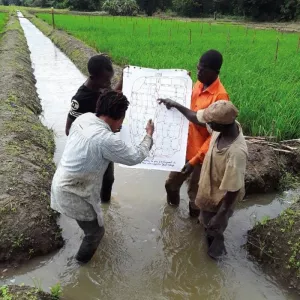
The Smart-Valleys approach of AfricaRice is a participatory and community-driven approach that enhances rice productivity input accessibility, and market linkages due to larger community-based input-output volumes.
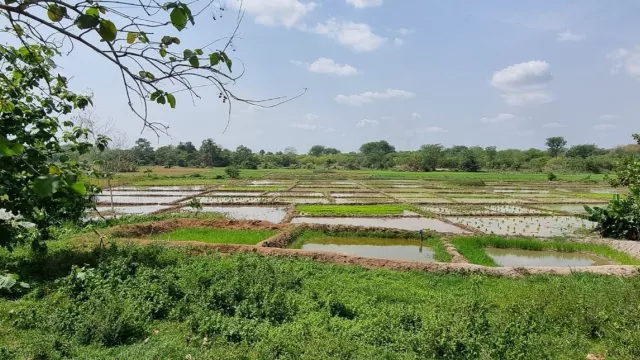
Inland valleys in Africa cover ±190 million hectares and are agricultural “bright spots” due to their high-water availability and fertile soils. These multifunctional landscapes support rice-based systems, as well as fish, vegetable, fruit, and livestock production while providing forest, forage, hunting, and fishing resources.
The Smart-Valleys approach of AfricaRice is a participatory and community-driven approach that enhances rice productivity input accessibility, and market linkages due to larger community-based input-output volumes. Our Smart-Valleys approach results in doubling rice yields from 2.0 to 4.0 t/ha at a cost of $700/ha, generating equivalent returns. These nature-based biodiverse systems along with the inclusive approach enhance resilience to production stressors like drought and flooding, build social capital and economic prosperity, and inherit the highest potential for attaining rice self-sufficiency in Africa.
A preliminary estimate suggests that $9 billion would be required to develop Smart-Valleys at a scale required for the African continent to be rice self-sufficient, i.e. to produce an additional 30Mt of rice by 2035, compared to the $6 billion spent annually on rice imports today.
Key strategies for the massive scaling of Smart-Valleys include:
- Smart-Valleys compendium: Developing a comprehensive reference document that consolidates knowledge, best practices, and technological innovations, enhances social capital, and designs business models, and inclusive processes for Africa's rice self-sufficiency.
- Mapping and prioritization: Conducting inland valley mapping to identify areas with the highest potential for scaling, guided by preliminary mapping in West Africa.
- Bundling of innovations: Integrating Smart-Valleys activities along the value chain including drought-resistant rice varieties, RiceAdvice digital application for fertilizer application, parboiling for enhanced grain quality, crop diversification to enhance productivity and climate resilience for better diets and nutrition, aligned to consumer preferences and smart marketing.
- Develop a financial and operational plan for the massive scaling of the Smart-Valleys approach.
- Partnering: Showcasing Smart-Valleys at local and global forums and building coalitions among donors, governments, the private sector, and local actors for co-investments in Smart-Valleys.
The financial and investment mechanisms include:
- Government-led investment: Converge public funds towards Smart-Valleys implementation, ensuring alignment with national agricultural development goals.
- Private sector engagement: Demonstrating viable business models for Smart Valleys development, farm-community contracting, agro-processing, and input and output supply chains to attract private sector investment.
- Leverage funding sources: Leveraging international funds, institutional investments, and donor funding with national programs for massive scaling.
Massive scaling of Smart-Valleys in Africa yields significant returns on investment, avoiding aberrant rice import costs while making Africa rice self-sufficient in the face of growing populations and changing climate.